Concept maps for studying: how to make one you can actually recall
A concept map is a drawing of how the parts of a topic connect: boxes for the ideas, arrows for the relationships, a word on each arrow saying what the relationship is. Students are told to make them and mostly do not, because the first attempt takes an hour and produces a tangle. This guide covers what a concept map is, what the research found, including the study usually quoted as proof that maps lose to self-testing, a six-step method, the three mistakes that make a map useless, and how to do it on a board where the AI draws the first draft and you do the recall.
What a concept map is, and is not
Novak, who developed the technique at Cornell in the 1970s, was specific about it [1]. A concept map has concepts in boxes, a linking phrase on each arrow, and the whole thing reads as a set of propositions: "insulin — lowers — blood glucose". It is hierarchical, with the broadest idea at the top, and it has cross-links between branches, which are the parts that show understanding rather than listing.
A mind map radiates keywords from a central word with no labels on the lines, so it records what you thought of. A concept map records what you think is true, and a labelled arrow can be wrong. If an arrow has no word on it, you have not yet decided what the relationship is.
What the research found
The evidence is good, with one important caveat. Nesbit and Adesope's meta-analysis of 55 studies found that learning with concept maps beat reading text, attending lectures and studying outlines, with a large effect when students made the map themselves and a smaller one when they studied a map someone else had made [2]. A 2018 update over 142 effect sizes found the same pattern: making a map helps more than reading one [3].
The caveat is Karpicke and Blunt's 2011 experiment, which is usually quoted as "testing beats concept maps" [4]. Students either built a concept map from a science text, with the text open, or put the text away and wrote down everything they could remember. A week later the retrieval group scored higher on both fact and inference questions. The map group had also rated their own learning higher, and scored lower.
The mapping students built their map with the text open, so they were organising rather than recalling. The same paper notes that making a map from memory counts as retrieval practice, and later work found that mapping from memory performs about as well as free recall [5]. Copying the book into boxes is weak. A map built from your head is a test, and the method below is built around that.
The method
- Write the focus question firstA map answers a question. "How does the body keep blood glucose steady?" is a question; "glucose" is a word. A map without a question sprawls, because there is no way to decide what belongs on it. Write the question at the top of the board and keep it there.
- List the concepts, then rank themFifteen to twenty-five concepts, as nouns, on sticky notes or in a column. Then order them from most general to most specific. "Homeostasis" is more general than "insulin", which is more general than "GLUT4 transporter". This ranking is the structure of the map and takes longer than you expect. It is also the first time you find out which concepts you cannot place.
- Close the source and draft the mapThis is the step that decides whether the map teaches you anything. Put the textbook or slides away. Place the general concepts at the top, the specific ones below, and draw the arrows from memory. Where you are not sure, draw the arrow anyway and mark it with a question mark.
- Label every arrowOne verb or short phrase on each: causes, inhibits, is released by, is a type of, requires. An unlabelled arrow is a relationship you have not yet understood, and if you cannot find the word you have found a gap. Read each box-arrow-box as a sentence and check it is true.
- Add the cross-linksNow look for arrows between branches, not just down them. Insulin sits under the pancreas; GLUT4 sits under muscle cells; the arrow between them is the cross-link, and cross-links are what the research identifies as the marker of understanding rather than recall. Aim for three to five.
- Open the source and correctOnly now bring the book back. Check each proposition. Fix the wrong arrows, resolve the question marks, and add what you missed in a different colour, so next week you can see what you did not know. Then put the map away and come back in a few days to redraw it on a blank patch. That redraw is the revision session.
Three mistakes that make a map useless
Doing it on a board
Concept maps belong on a canvas, because the whole point is to see the structure at once, move boxes until the arrows stop crossing, and come back to it. Paper works. A board helps in two ways.
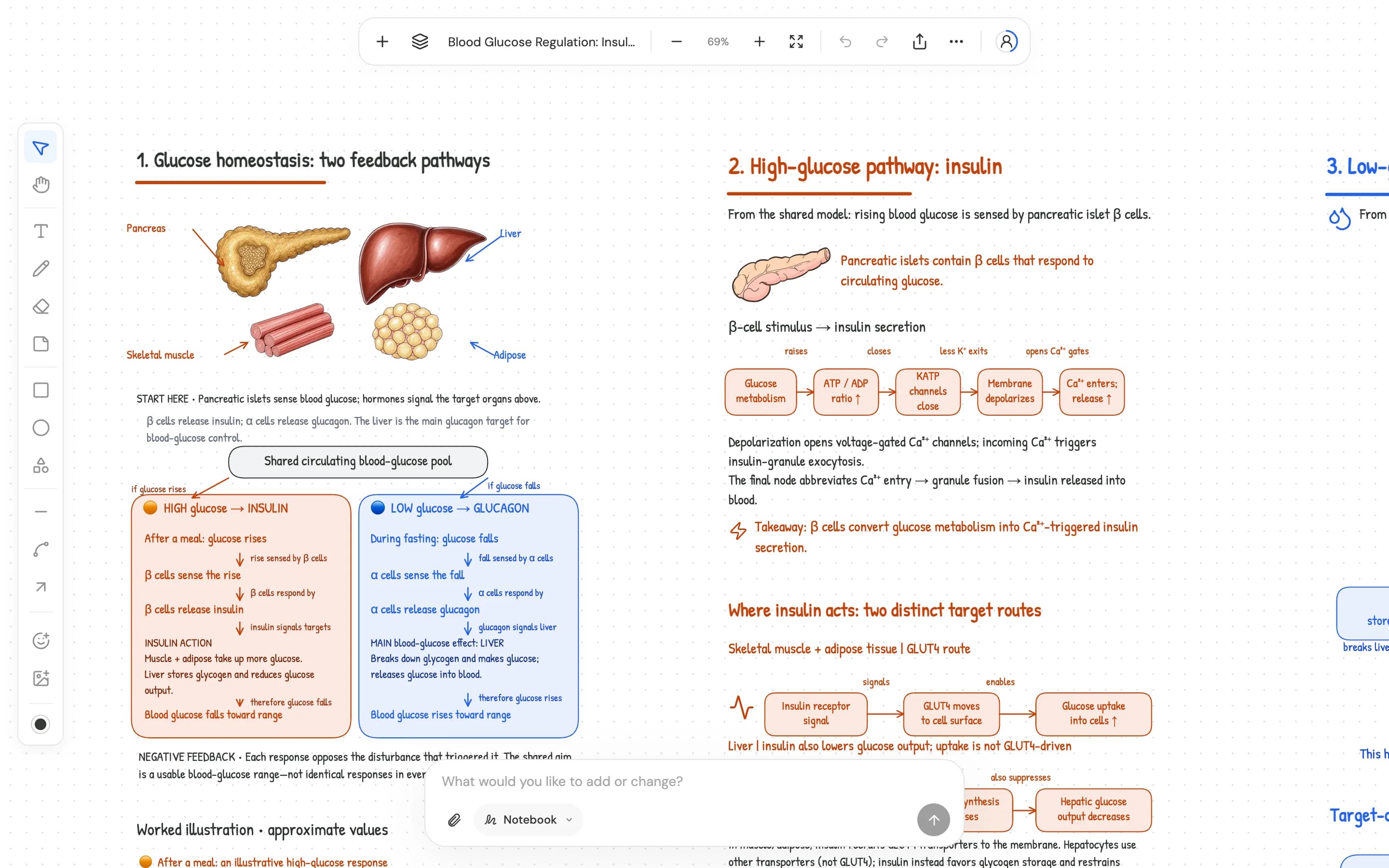
The first is that the map keeps changing. Boxes move, arrows follow, and you can drag a branch that got big into its own map and link it back. The second is the first draft. Use Ask to get a concept map of a topic, as in the picture above, and it writes one on the board: boxes, labelled arrows, laid out in space. The research on studying a map someone else made says that helps a little. What helps a lot is what you do next, and the draft makes it easy to do: scroll it out of view, draw your own version on a blank patch from memory, then bring the two side by side and compare. Every arrow in the AI's map that is missing from yours is a gap. Every arrow in yours that is missing from the AI's is either an insight or an error, and you can select the arrow, mention it in chat and ask which.
With your slides or chapter on the same board as a source, the first draft is built from your material and each box cites the page it came from, so step six, checking the propositions, is a click rather than a search. And when the map is right, ask Quizbook to hand it back to you with the labels removed and grade you on filling it in. That is the redraw from step six, with marking.
Questions
Concept map or mind map?
Concept map for anything with a mechanism, a hierarchy or a causal chain, which is most of science, economics, law and medicine. Mind map for generating ideas, planning an essay or brainstorming, where the links do not need to be true, only suggestive.
Is a concept map better than flashcards?
They do different jobs. Flashcards drill discrete facts; a map tests whether you know how the facts connect. For a mechanism, a map finds gaps that a hundred cards would miss. For a hundred drug names, the cards win. Most courses want both, and Bord keeps the map and the deck on the same board.
How many concepts should a map have?
Fifteen to twenty-five, answering one focus question, fitting one screen. More than that and it becomes two maps.
How long does it take?
The first map of a topic takes about forty minutes done properly, most of it in ranking the concepts and labelling the arrows. The redraw from memory a few days later takes ten, and that is the one that does the most for the exam.
Can the AI just make the map for me?
Yes, and it should make the first draft, because a draft to compare against is useful and drawing boxes is not learning. Then close it and draw your own. If you only read the AI's map, you are in the Karpicke and Blunt open-book condition with better graphics. There is more on this split in how to study with AI without cheating yourself.
What does Bord cost?
Free to try as a guest, with no account. Files need a free account. See pricing.
Sources
- Novak, J. D., & Cañas, A. J. (2008). The theory underlying concept maps and how to construct and use them. Technical Report IHMC CmapTools 2006-01 Rev 01-2008. Florida Institute for Human and Machine Cognition.
- Nesbit, J. C., & Adesope, O. O. (2006). Learning with concept and knowledge maps: A meta-analysis. Review of Educational Research, 76(3), 413–448.
- Schroeder, N. L., Nesbit, J. C., Anguiano, C. J., & Adesope, O. O. (2018). Studying and constructing concept maps: A meta-analysis. Educational Psychology Review, 30(2), 431–455.
- Karpicke, J. D., & Blunt, J. R. (2011). Retrieval practice produces more learning than elaborative studying with concept mapping. Science, 331(6018), 772–775.
- Blunt, J. R., & Karpicke, J. D. (2014). Learning with retrieval-based concept mapping. Journal of Educational Psychology, 106(3), 849–858.
Try it on a board of your own.
No account needed to start. Guest boards stay on your device.